
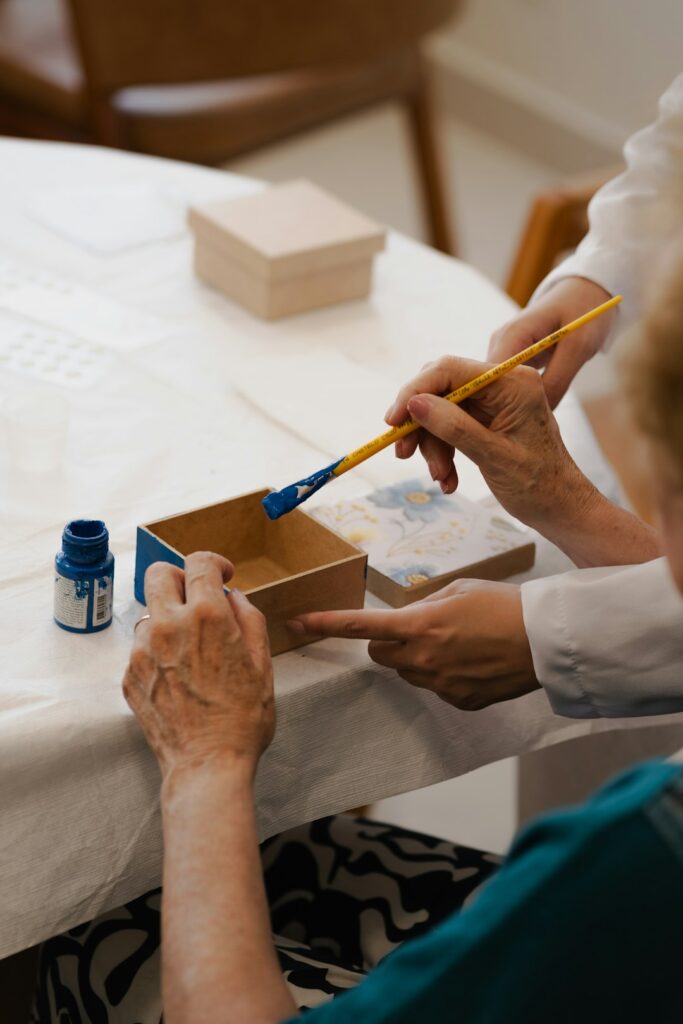
Creative hobbies can give assisted living residents meaningful ways to use their time, express themselves, connect with others, and maintain familiar routines. The most successful activities are not necessarily complicated or expensive. They are enjoyable, adaptable, and suited to a person’s abilities, interests, energy level, and past experiences.
Why are creative hobbies helpful for older adults?
Creative activities support more than entertainment. They can encourage conversation, hand movement, memory recall, decision-making, and a sense of personal accomplishment.
A hobby may also provide structure during parts of the day that otherwise feel long or unplanned. Completing a small project can offer a clear beginning and ending, while group activities create regular opportunities for social contact.
Creative hobbies may help residents:
- Express preferences and personality
- Reconnect with earlier interests
- Practice fine-motor movements
- Stimulate memory through familiar sights, sounds, and materials
- Reduce boredom and restlessness
- Build friendships through shared activities
- Create decorations, gifts, or keepsakes
- Maintain a feeling of independence
The goal is not artistic perfection. Enjoyment, participation, and personal meaning matter more than the finished product.
Which hobbies work well in assisted living?
The best hobby depends on the resident’s interests and abilities. Activities should be flexible enough to allow participation while seated, with assistance, or in short sessions.
Painting and drawing
Watercolor painting, colored pencils, markers, and simple sketching can be adjusted for different skill levels. Residents might paint flowers, landscapes, seasonal scenes, or objects placed on a table.
Large-handled brushes and pencils may be easier to hold than narrow tools. Non-spill cups, washable supplies, and sturdy paper can reduce frustration and cleanup concerns.
Drawing from memory can also prompt conversation. A resident may sketch a former home, favorite garden, family gathering, or familiar landscape.
Collage and paper crafts
Collage activities are useful for residents who enjoy choosing colors and arranging materials but may find detailed drawing difficult. Paper, fabric scraps, greeting cards, photographs, and textured materials can be combined into simple designs.
Possible projects include:
- Seasonal wall art
- Memory collages
- Greeting cards
- Bookmarks
- Decorative paper flowers
- Family-themed picture boards
Pre-cut pieces can make the activity easier for people with limited hand strength or vision changes.
Knitting, crocheting, and textile crafts
Some residents enjoy knitting, crocheting, embroidery, needlepoint, or simple sewing because these activities are familiar and repetitive. Even when a person can no longer complete a large project, they may enjoy sorting yarn, selecting colors, practicing a few stitches, or working on a small square.
Adaptive options may include larger needles, thicker yarn, simplified patterns, and nonslip mats. Residents who once made clothing or blankets may appreciate talking about past projects as much as participating in the craft itself.
Music and rhythm activities
Music is a creative hobby even when a resident does not play an instrument. Singing familiar songs, tapping along with a rhythm, learning simple percussion patterns, or listening to personally meaningful music can encourage involvement.
Residents may enjoy creating playlists based on life periods, holidays, dances, or family traditions. Music can also support reminiscence. A song may lead to stories about work, school, military service, marriage, travel, or community celebrations.
In assisted living, volume and sensory comfort should be considered. Some residents may prefer quiet listening or individual headphones rather than a large group performance.
How can memory-supportive hobbies be adapted?
Residents living with memory loss can still participate in creative activities, but the process may need to be simplified. Familiar, repetitive, and sensory-based projects are often easier than activities requiring several complicated steps.
Helpful adaptations include:
- Offering one or two choices instead of a crowded supply table
- Demonstrating each step slowly
- Using large, high-contrast materials
- Keeping sessions brief and predictable
- Avoiding correction when the result looks different from the example
- Focusing on conversation and enjoyment rather than accuracy
- Providing hand-over-hand assistance only when welcomed and appropriate
Sorting buttons by color, arranging flowers, folding fabric, decorating cookies, or placing stickers can all be creative experiences. A resident does not need to complete a formal project to benefit from participating.
Are gardening activities possible in assisted living?
Yes. Gardening can be adapted for indoor spaces, balconies, patios, or accessible outdoor areas. In Fleetwood, PA, changing seasons and cold-weather periods make indoor planting and nature-based crafts useful parts of the yearly activity schedule.
Residents might grow herbs in small containers, plant seedlings, arrange flowers, press leaves, or decorate pots. Tabletop gardening can be done while seated, provided containers are stable and water is easy to manage.

Seasonal activities may include:
- Planting bulbs or indoor herbs
- Making arrangements with dried flowers
- Creating bird-themed crafts
- Decorating pinecones or branches
- Painting garden markers
- Observing changes in daylight, weather, and local plant life
Outdoor activities should account for heat, cold, glare, uneven surfaces, and the resident’s endurance. Indoor alternatives help maintain continuity when weather limits outdoor time.
What creative hobbies are suitable for residents with limited mobility?
Limited mobility does not eliminate creative choices. Many hobbies can be performed at a table, in a wheelchair, or from a comfortable chair.
Good options include painting, coloring, photo organization, music listening, storytelling, flower arranging, clay modeling, bead sorting, and digital or recorded storytelling. A lap tray or adjustable table may improve positioning.
Tools should be placed within easy reach, and projects should not require prolonged bending, standing, or carrying heavy supplies. Rest breaks are part of the activity, not a sign that the resident has failed.
For residents with tremors or reduced grip strength, larger tools, weighted handles, clipboards, non-slip materials, and preassembled project pieces may help. Activities should be changed if pain, fatigue, frustration, or unsafe posture develops.
How can family members support a resident’s creative interests?
Family members can help by learning what the resident enjoyed earlier in life rather than assuming that every older adult wants the same activities. Questions about past hobbies may reveal interests in cooking, woodworking, photography, quilting, writing, music, decorating, or gardening.
Useful contributions may include:
- Sharing copies of family photographs for a collage
- Bringing large-print recipes or favorite poems
- Labeling supplies clearly
- Asking the resident to explain a familiar skill
- Displaying completed work at an appropriate height
- Participating without taking over
- Recording stories connected to the activity
A project can become more meaningful when it reflects the resident’s history. Someone who does not want to “make art” may still enjoy organizing family photos, choosing fabric colors, or telling the story behind an old recipe.
What should assisted living staff consider before starting an activity?
Activities should be safe, accessible, and voluntary. Supplies must be appropriate for the resident’s vision, hearing, dexterity, swallowing safety, and cognitive abilities.
Avoid small pieces for residents who may place objects in their mouths, sharp tools for people who cannot use them safely, and materials with strong odors that may trigger discomfort. Food-based crafts require attention to allergies, dietary restrictions, and swallowing concerns.
The activity area should have adequate lighting, stable seating, clear pathways, and enough space for mobility devices. Staff should also watch for sensory overload. A busy room, loud music, or too many choices can make participation harder.
The most effective creative program offers variety without pressure. Some residents will enjoy a group project, while others may prefer quiet individual work. Both forms of participation are valid.
How often should residents participate?
There is no single schedule that suits everyone. Short, regular sessions are often more manageable than occasional activities lasting several hours. Ten to thirty minutes may be enough for a resident with limited stamina, while another person may enjoy a longer project with breaks.
Creative hobbies can be included in daily routines, weekly groups, family visits, or seasonal celebrations. The activity should remain flexible so residents can stop, observe, talk, or return to the project later.
A finished object is not the only measure of success. Choosing materials, remembering a past experience, sharing a story, or spending pleasant time with another person can be the most valuable part of the hobby.
